Privacy
Privacy by Design in Identity Verification
How to confirm a person is real while keeping sensitive biometric material off your servers.
4 min · October 2026
Read More: Privacy by Design in Identity VerificationMissing a country or a custom check? Tell us what you need.Book a 15-min call
Phorsys ran a black-box penetration test on secuveri. We received the report, fixed every finding and retested it ourselves, all on the same day.
By secuveri teamPublished
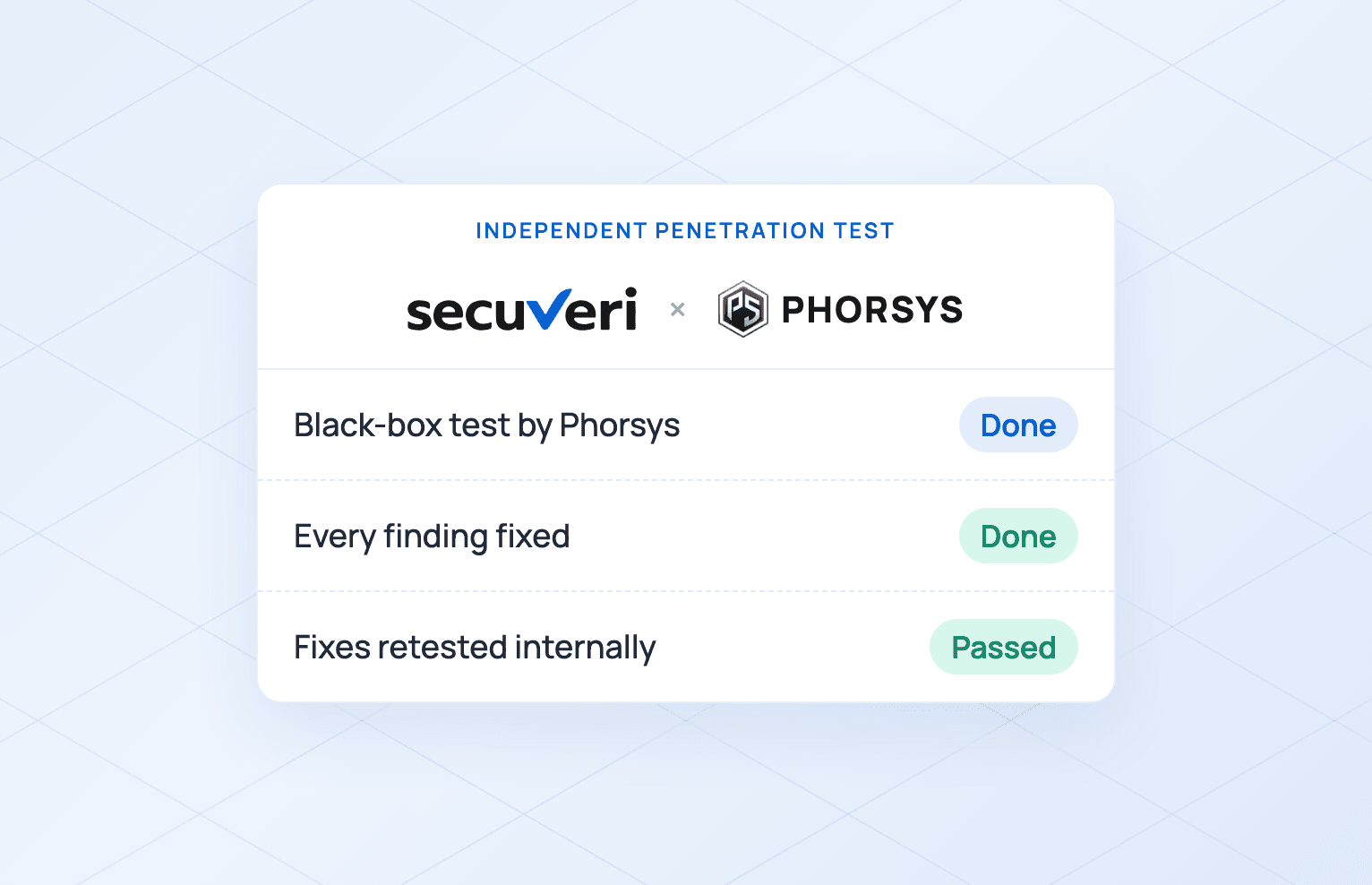
On 9 November 2026 we received the final report from an independent penetration test of our platform. By the end of that day we had fixed every finding, deployed the fixes to production and written our internal retest report.
This post explains how the test worked, what we changed and why we asked for it. Our security page covers the controls we run every day.
Our customers send us passports, ID cards and selfies. They trust us to keep that data safe. Saying a platform is secure is easy. Showing it takes evidence that does not depend on our own word.
So we asked an independent team to attack us. Phorsys, a French offensive security firm that specialises in penetration testing and fraud, ran the test.
"We handle identity documents and biometrics, so we want to know where we are weak before anyone else does. The Phorsys team attacked us like a real adversary would, and their report made every fix clear. That is why we could close everything in a day."
Artus Guenes, CEO of secuveri
Phorsys ran a black-box test. Their team started from our public web address and nothing else: no code, no internal documents and no special access.
They mapped what we expose, scanned it with automated tools, then tested by hand. That covered sign-up and login, sessions, access control between organisations, input handling, business logic and configuration. On 8 November they gave us a hot debrief, and the written report followed.
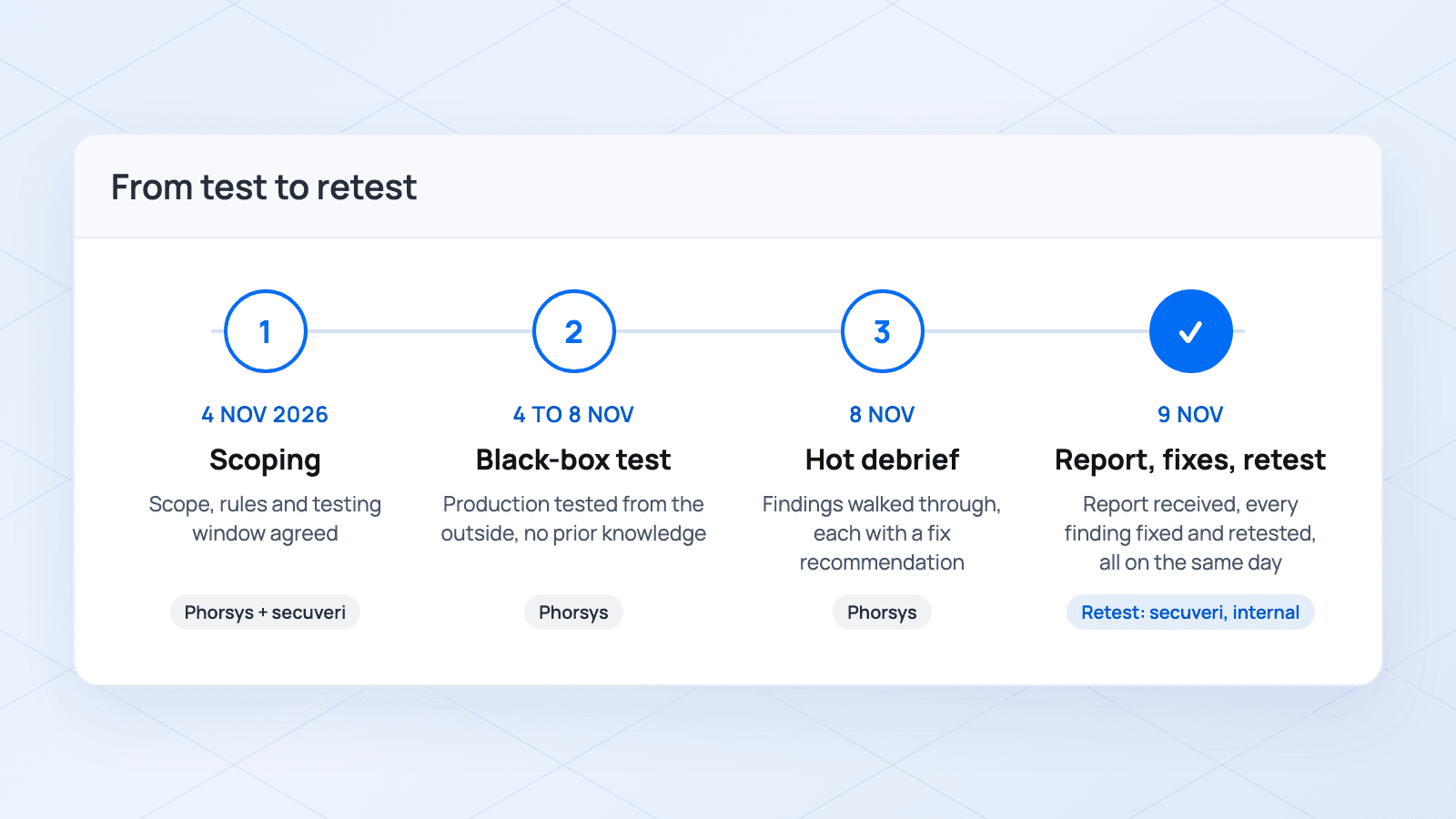
The platform held. Phorsys did not compromise it in the time available, and none of the outcomes we feared most happened. Nobody reached data without an account, read another customer's data or took over an admin account or a server.
The report names effective access control, sound authentication on the features tested and robust, proven components as strengths.
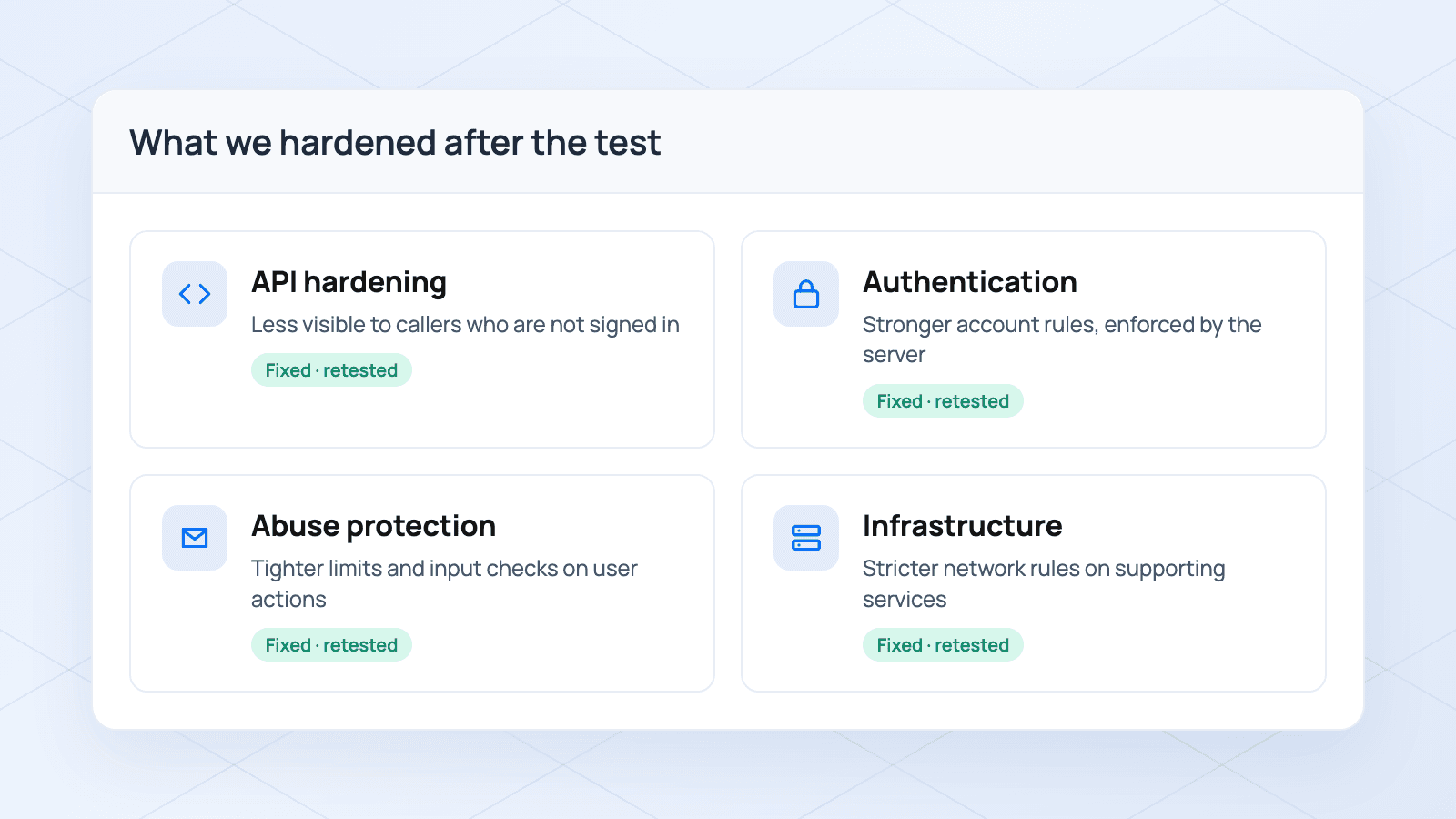
The test also surfaced a set of issues around API hardening, authentication and abuse protection. Each came with a clear explanation and a concrete fix. That is exactly what we wanted from the test: specific things to improve, found by someone who thinks like an attacker.
We fixed every finding on the day we received the report and deployed the changes to production. In broad terms, we:
We keep the technical details private. Publishing them would help attackers more than it would help customers.
The retest was done by secuveri, internally, not by Phorsys. On the same day, we repeated each of Phorsys's tests against production, from the outside, with the same kind of tools. Every test that had worked before now failed. Our retest report records the method and evidence for each item, and we added one extra hardening step while we were at it.
Phorsys recommends an independent counter-audit after fixes, and we agree. That counter-audit has not happened yet. Until it does, the fixes are verified by our own testing.
A penetration test also has limits, and the Phorsys report states them openly. It covers a defined scope over a fixed time, and the result is a snapshot. A black-box test can miss things that someone with inside knowledge would see. That is why we treat testing as something we repeat, not a box we tick once.
If you are a compliance officer or CTO assessing us, here is the short version:
Customers and auditors can ask us for the Phorsys report and our retest report. The same thinking runs through the rest of the platform: verification data is processed and stored in the EU (Vienna, Austria) with encrypted backups in Germany, our models are built in-house and every outcome is a signed result. Our compliance page has more detail.
Thank you to the Phorsys team for a careful, well-run test. If you need a black-box penetration test, or want to know how your KYC flow holds up against forged documents and deepfakes, talk to Phorsys.
This article is general information, not legal or compliance advice. Your obligations depend on your sector, licence and markets.

See how secuveri protects your verification data.
How to confirm a person is real while keeping sensitive biometric material off your servers.
4 min · October 2026
Read More: Privacy by Design in Identity Verification
What businesses need to know about compliance when verifying identities across markets.
5 min · October 2026
Read More: Understanding Digital Identity ComplianceTell us what you’re trying to verify. We’ll show you how secuveri can fit your workflow.